Residential Proxy Performance: The Complete Guide
Updated October 8, 2026

Residential Proxy Performance: The Complete Guide
What is residential proxy performance? It is the combination of response time, successful requests, reliability, and bandwidth efficiency that determines whether a residential proxy can support a workload. For developers and business teams, useful performance means completing authorized tasks consistently within acceptable time and resource limits, rather than achieving the fastest isolated request.
A quick response has little value if it contains an error, loses session state, or requires repeated attempts. Services such as IP9's residential and mobile proxies therefore need to be evaluated against the application they will support, using repeatable measurements rather than a single speed test.
What is residential proxy performance?
A residential proxy routes traffic through an exit associated with a residential internet connection. Its performance reflects the complete request path: the client, proxy gateway, residential exit, destination, and return journey. A delay anywhere along that path can affect the result.
That makes performance a workload-specific property. An application retrieving small responses may depend mainly on connection time and time to first byte. A browser workflow also depends on downloaded resources, script execution, and page behavior. For a recurring job, predictable completion may matter more than the quickest individual response.
For example, IP9 offers residential proxies with rotating IPs. Rotation describes an IP-handling capability, not a guarantee about latency or completed work. Its effect should be measured alongside session requirements and destination behavior.
Residential connections can introduce more speed variation than datacenter alternatives because traffic passes through consumer networks. That general distinction doesn't determine the best option for every application, and it doesn't establish a performance ranking between providers.
A useful evaluation ends with an operational decision: whether the configuration meets the workload's requirements, where it fails, and what resources are needed to maintain acceptable results.
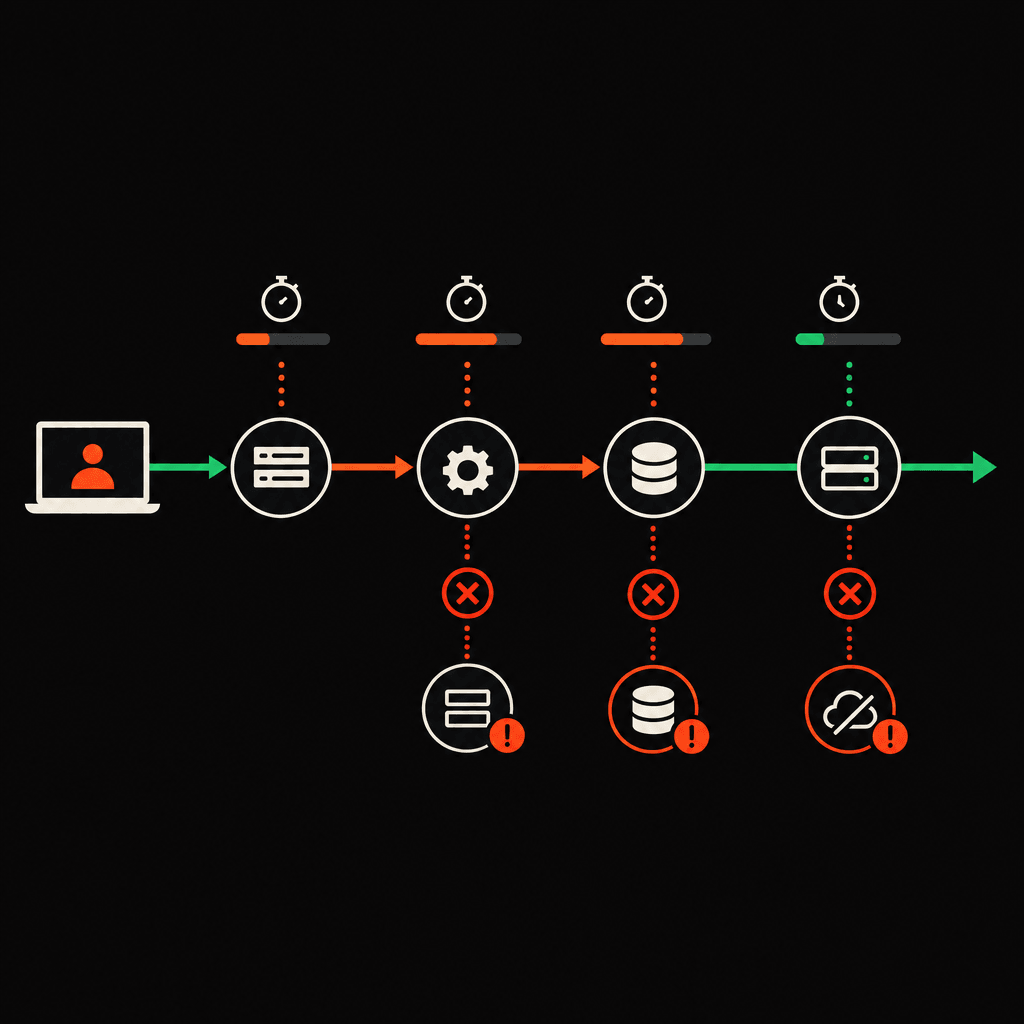
Residential Proxy Connection Timeout: Common Causes and First Checks
A residential proxy connection timeout occurs when a connection attempt exceeds the client's configured deadline. It differs from a response timeout, which can occur after a connection has already been established. Libraries sometimes group these failures under similar messages, so the exception details matter.
Common causes include an incorrect gateway address, blocked outbound traffic, name-resolution problems, an unreachable exit, or a destination that isn't accepting connections promptly. Authentication failures usually deserve their own classification rather than being treated as generic timeouts.
The first checks are straightforward: confirm the endpoint, port, protocol, credentials, and permitted network access. Then compare an authorized control destination with the affected destination under the same conditions. A permitted direct request can provide additional context, although it follows a different route.
Increasing a timeout may accommodate slow requests, but it doesn't repair an unavailable route and can leave workers occupied longer. The dedicated topic, Residential Proxy Connection Timeout, is intended for deeper troubleshooting; this initial classification identifies which stage needs investigation.

How to Reduce Residential Proxy Bandwidth Usage
Bandwidth efficiency means transferring fewer unnecessary bytes without losing required information. It isn't simply a smaller response: failed attempts, duplicate downloads, retries, and browser resources can all contribute to total traffic.
Improving residential proxy performance through bandwidth reduction starts with measuring bytes per valid result. Application owners can then identify repeated requests, oversized payloads, unnecessary assets, and retry loops. Where destination permissions and application requirements allow, requesting narrower responses or reusing valid application-side data can reduce waste.
Browser resource blocking requires particular care. Removing images or scripts may change page behavior, prevent required data from loading, or make the result unsuitable for its intended use. Each change needs a content-validity check.
Commercial residential proxy gateways shouldn't generally be assumed to cache destination content. Any caching strategy needs explicit application ownership, freshness rules, and appropriate handling of sensitive data.
The deeper topic, How to Reduce Residential Proxy Bandwidth Usage, centers on identifying waste without breaking workflows. At the overview level, total bytes divided by valid completed results is the most useful starting measurement.
Key Performance Metrics: Latency, Success Rate, Throughput, and Bandwidth
Residential proxy performance needs a small set of complementary measurements. An average response time alone can hide slow outliers, failed requests, and excessive transfer costs.
Latency and response time
Residential proxy latency describes delay, but a report should identify the interval being measured. Connection setup, time to first byte, and complete response download are different measurements.
Time to first byte, or TTFB, measures the interval between sending a request and receiving the first response byte. Full load time measures how long an entire page takes to finish loading. Neither should be presented as interchangeable with complete job duration.
Success rate and reliability
Residential proxy success rate should use a declared definition of success. A successful HTTP status doesn't prove that the expected content arrived. A valid result may also require the correct schema, required fields, appropriate session state, and complete content.
Reliability adds consistency over time. It includes whether jobs continue completing across repeated runs and whether failures recover within acceptable limits.
Throughput and bandwidth
Throughput measures completed work per unit of time. Attempted requests can rise while useful throughput falls if errors and retries increase. Bandwidth measures transferred data; bytes per valid result connects that consumption to useful output.
| Workload | Leading measurements | Essential guardrail |
|---|---|---|
| Small API responses | TTFB and valid response rate | Expected schema and content |
| Browser workflows | Full load and task completion time | Required page behavior remains intact |
| Recurring batch jobs | Valid completions and bytes per result | Stable results across repeated runs |
Business reporting should connect these measurements to delivery requirements. A technically faster setting may still be unsuitable if it increases traffic consumption or makes completion times unpredictable.
What Affects Performance: Network Paths, Destinations, Payloads, and Concurrency
Geography matters, but the actual network path matters more than a location label alone. The client-to-gateway route and exit-to-destination route both contribute to delay. Destination infrastructure and network conditions can also vary between requests.
Payload size changes what a test measures. A small response emphasizes connection and server delays; a larger response makes transfer speed more visible. Comparisons become misleading when one test downloads a lightweight endpoint and another loads a resource-heavy page.
Residential proxy concurrency introduces another tradeoff. More simultaneous requests may improve completed work until a client, gateway, route, or destination becomes constrained. Beyond that point, additional concurrency can increase queues, timeouts, and retries instead of useful output.
Distributing authorized, stateless jobs across healthy exits can prevent a single route or source address from becoming a bottleneck. Stateful workflows need separate consideration because changing exits may interfere with session expectations. Distribution should never be treated as permission to bypass destination restrictions.
Before any automation tutorial is published, it must be checked against the full IP9 Acceptable Use Policy, including its permitted-use, prohibited-use, and responsible-automation requirements. Destination authorization and access rules also remain part of the test design.
A proxy can't repair slow database queries, render-blocking JavaScript, oversized API responses, or an overloaded origin server. Teams that skip these distinctions can spend time changing proxy settings while leaving the actual bottleneck untouched.
How to benchmark residential proxy performance step by step
Residential proxy benchmarking starts with a written test contract: the permitted destinations, required outputs, controlled conditions, and criteria for acceptance. This keeps the evaluation tied to useful work rather than whichever measurement looks best.
- Define authorized test destinations. The test owner records permission, applicable access limits, representative endpoints, and a control destination. Tests must stay within those boundaries.
- Specify valid results. Each request type gets a content check, such as required fields or expected page elements. Status codes are recorded separately from application-level validity.
- Keep payloads consistent. The comparison uses matching methods, request bodies, headers, response expectations, and browser resource policies wherever practical.
- Control concurrency. The starting configuration uses a documented level of parallel activity. Client resources, connection handling, and retry behavior remain unchanged during the comparison.
- Capture timing stages. Available measurements distinguish name resolution, connection establishment, TLS negotiation, TTFB, complete transfer, and job completion. Missing timing fields are recorded as unavailable, not estimated.
- Classify every outcome. Connection errors, authentication failures, response timeouts, destination responses, invalid content, and application parsing failures get distinct labels.
- Record bytes transferred. Traffic measurements include retries where observable. The report distinguishes client-side measurements from provider-reported billable usage.
- Repeat and retest one variable at a time. Matching runs compare the baseline with a single configuration change, with enough repetition to reveal variability.
Each result record should also include a timestamp, destination identifier, configuration label, attempt count, and whether the final output passed validation. Credentials and sensitive response content don't belong in ordinary benchmark logs.
A minimal sample can reveal configuration failures, but a production decision needs observations across representative conditions. Successful-request timings and failure counts should remain visible separately so that fast failures don't make a configuration appear efficient.
The final report should explain both the result and its boundaries: which workload was tested, which conditions were controlled, what varied, and whether the acceptance criteria were met. A benchmark without that context is difficult to reproduce.
How to Diagnose Slow Requests, Errors, and Inconsistent Results
Diagnosing residential proxy performance works best when the investigation follows the request lifecycle. The first task is to locate the delay or failure, rather than assigning responsibility to the proxy immediately.
Before a connection is established
Widespread failures across authorized destinations point toward shared dependencies worth checking: client configuration, credentials, DNS, local network rules, gateway access, or client resource exhaustion. A failure limited to one destination suggests a narrower route or destination issue, though it doesn't prove the cause.
After connection setup
When TCP and TLS complete quickly but TTFB remains high for one domain, investigation should include that domain's application latency, rate limits, and response size before changing the proxy. Destination-side timing logs, when available to the application owner, can help separate server processing from network delay.
And a fast first byte followed by a slow transfer points to a different investigation: payload size, available transfer capacity, interrupted streams, or client-side handling.
After content arrives
Parsing failures, missing fields, and broken session flows are application-level symptoms even when the network request completed. They need content validation and workflow inspection, not simply longer timeouts.
For inconsistent results, group observations by destination, request type, configuration, and test period. Aggregating unlike requests can make a stable workload look erratic or conceal a problematic subset.
The most useful incident summary separates observed facts from hypotheses. “Connection completed, response deadline expired” is actionable evidence; “the proxy is slow” is a conclusion that still needs testing.
How to Test Performance Improvements Without Sacrificing Reliability
Every proposed improvement needs a guardrail. A shorter deadline may improve average completion time only because slow requests are abandoned. Blocking browser resources may reduce traffic while removing required content. Increasing parallel work may raise attempted requests without producing more valid results.
A controlled comparison keeps the destination set, payload, validation rules, retry policy, and execution environment consistent. Only the variable under investigation changes. Repeated baseline runs help distinguish a configuration effect from ordinary variation.
Acceptance criteria should be established before the result is reviewed. A team might require that valid completion and content quality remain acceptable while transfer usage falls, or that job duration improves without increasing unresolved failures. The thresholds come from the workload, not a universal proxy score.
Provider background is a separate evaluation track. The IP9 company overview can inform organizational due diligence, but company information doesn't replace workload-specific measurements.
A candidate change should also have a rollback condition and an owner. If results deteriorate after deployment, the team needs a known-good configuration and enough telemetry to explain the difference.
The strongest improvement is one that survives repeated tests and remains useful under representative conditions. A single unusually fast run isn't sufficient evidence for a production change.
How to Choose Residential Proxies for Your Performance Requirements
Choosing a service for residential proxy performance starts with requirements that can be tested. Those requirements should describe the destination set, expected response sizes, session behavior, permitted concurrency, delivery deadlines, and acceptable failure handling.
These are evaluation criteria, not claims that every provider supports the same controls. Teams should confirm available protocols, location options, session settings, usage accounting, and operational limits directly before designing around them.
The IP9 residential proxy page is a relevant product starting point. IP9's verified offering includes residential proxies with rotating IPs; the effect of that rotation on a particular workload still needs measurement.
IP9 also offers Unlimited Mobile Proxies. That offering shouldn't be treated as evidence that mobile and residential services have identical behavior, limits, or workload suitability. Product selection requires confirmation of the applicable terms and a representative test.
For budget planning, IP9's pricing page includes a Pricing Calculator and Available Locations. A useful estimate combines the current applicable pricing with measured traffic consumption, including unsuccessful attempts and retries where billed. Cost per valid completed result is more informative than a headline unit price alone.
Operational fit matters alongside technical results. Clear configuration guidance, usable troubleshooting information, and an understood escalation process all belong in due diligence. IP9 provides Integration Tutorials and a Residential Proxies Quick Start as developer-oriented starting points.
The final decision should document tradeoffs. A configuration may be acceptable for small stateless requests but unsuitable for long browser sessions; that is a workload boundary, not necessarily a contradiction.
Getting Started: Verify Configuration, Run a Baseline, and Monitor Changes
An initial rollout should make residential proxy performance observable before traffic expands. Configuration, measurement, and ownership need to be in place together; otherwise, later changes become difficult to explain.
The setup owner first checks the gateway details, authentication method, client proxy support, certificate handling, and timeout settings against current documentation. IP9's Integration Tutorials and Quick Start can support that configuration review without implying particular integration features beyond their documented instructions.
A baseline then captures representative authorized requests with fixed payloads and controlled parallel activity. The stored configuration should identify the client environment, retry behavior, validation rules, and measurement method. Sensitive values should remain outside shared reports.
- Request health: valid completions, error categories, retries, and response-time distributions.
- Workload health: completed jobs, unfinished work, session continuity, and result quality.
- Resource health: transferred bytes, client capacity, and usage-accounting differences.
- Change history: deployment updates, proxy configuration changes, and destination behavior changes.
Monitoring needs an operational owner who can distinguish a destination incident from a client release or configuration change. For infrastructure professionals considering work on the provider side, the IP9 careers page provides the relevant employment information; it isn't evidence of service performance.
After deployment, comparisons should use the same definitions as the baseline. If the application changes its payloads, destinations, or success criteria, the baseline may need updating rather than being treated as permanently representative.
And monitoring should trigger an investigation, not an automatic assumption about fault. The same symptom can arise from several layers of the request path.
FAQ
What is a good residential proxy performance result?
A good result meets the workload's requirements for valid completion, response time, consistency, and resource consumption. There isn't a universal speed threshold that establishes suitability. Comparisons need matching destinations, payloads, concurrency, and validation rules; otherwise, the results may describe different workloads rather than better or worse service.
Does rotating an IP make requests faster?
Not automatically. A different exit may change the route and its behavior, but rotation can also affect session continuity. Authorized, stateless jobs may benefit from distribution across healthy exits when a single route is constrained. Stateful workflows need testing that preserves their required session behavior.
Can a longer timeout solve connection failures?
A longer deadline can accommodate an operation that is slow but still progressing. It won't correct invalid credentials, blocked outbound access, or an unreachable endpoint. It may also leave workers occupied longer. The relevant check is whether the deadline matches expected behavior and which connection stage actually failed.
Why can a successful status code still count as failure?
The returned content may be incomplete, unexpected, or unusable by the application. A response can pass an HTTP-status check while failing a schema check or missing required data. Separating transport success, destination status, and application validity prevents misleading success-rate reports.
Should bandwidth optimization come before speed optimization?
The priority depends on the measured constraint. Excessive retries or unnecessary downloads may make bandwidth reduction the most useful first change. If small requests spend most of their time waiting for the destination, reducing response size may have limited impact. A baseline identifies which problem deserves attention first.
The next deep-dive topics are Residential Proxy Connection Timeout for connection failures and How to Reduce Residential Proxy Bandwidth Usage for excess traffic. On the next test run, residential proxy performance should be checked against the same valid-result definition, timing stages, and bytes-per-result baseline before any improvement is accepted.